
Custom software can be used to directly integrate into existing work pipelines and design, monitor and analyse trials using cutting-edge methods.

E: rajat@musigmas.com
In today’s evolving clinical research landscape, software enabling fast simulations are transforming how trials are designed, monitored, and analysed
In today’s evolving clinical research landscape, software enabling fast simulations are transforming how trials are designed, monitored, and analysed. At an even larger scale most modern statistical methodologies rely on simulations to get further insight into the mathematical proofs. These simulation processes often use large data and several iterations along with advanced statistical methods and hence the need for custom implementations.
Innovative trial designs are needed to achieve efficiency, robustness and mitigation of risks arising from uncertainties in design parameters like effect size, variability, prevalence/incidence and population characteristics. These complex designs often need to be optimized with respect to these design parameters. This is achieved via extensive simulation of the candidate trial designs under different scenarios and as a result these designs are often referred to as simulated-guided designs. Efficient designs can be achieved by optimizing with respect to sample size, allocation-ratio, timing and number of interim looks, decision rules for interim looks, analysis methods, consideration for estimands, success criteria etc.
We have many years of experience in putting together such simulation routines as custom software with an intuitive graphical user interface (GUI) such that even non-programmers can simulate and optimize the trial. We have implemented many such simulation-guided design software across therapeutic areas, for early and late phases along with seamless options and both in the frequentist and Bayesian frameworks.
We equip these web-based applications with the ability to run simulations in parallel and deploy them in environments with large memory. These features allow for quick iterations through multiple design options and subsequent finalisation of the design. The applications provide helpful outputs such as - summary tables, interactive flowcharts and plots that can be used to communicate design ideas with non-statisticians as well as for regulatory purposes.
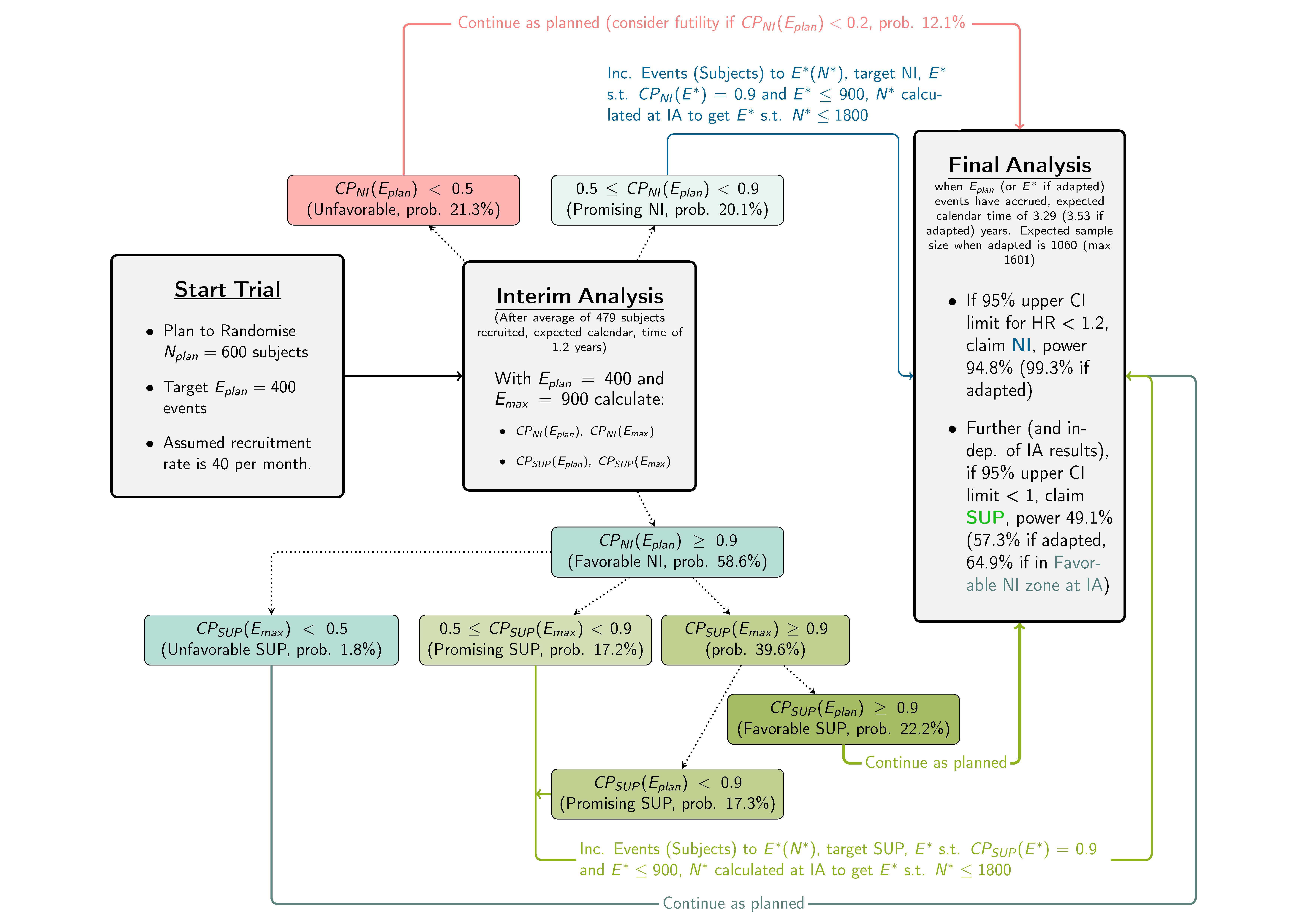
The schematic diagram shown below is an example output for an adaptive non-inferiority to superiority design for a composite time-to-event endpoint in a confirmatory cardiovascular disease trial.
Some examples of such tools recently developed by us are:
Monitoring apps are used for tracking the progress of clinical trials that span over years. For such trials, blinded monitoring of missed visits, time to events of interest and corresponding adjudication, prediction of time to achieve recruitment of target number of subjects and/or events, site-wise statistics of enrolment, lost-to-follow-up, protocol deviations, missed visits, intercurrent events (ICE), etc. are important metrics that can help identify and mitigate the risk of delays and revise downstream planning of database locks, interim and final analyses etc. We have built custom apps so that clinical trial operators can track these metrics on intuitive and interactive dashboards.
GUI-based custom applications enable clinical trial operators to monitor trial progress by uploading data directly or connecting these tools to databases through APIs, and to generate reports without spending additional time on data analysis. These applications are built with data checks for example for dates, out-of-range endpoint values and/or outliers. These tools can also be extended to open-ended observational and cohorts studies for post-marketing and real-world evidence generation.
For trial using de-centralized tools, these apps can be directly connected to databases. Connecting apps to databases through APIs enables secure, standardized access to data without exposing the database directly. The API acts as a communication bridge—handling authentication, queries, and data transfer between the application and the backend database.
The third major use case for custom apps is the analysis of clinical trial data with the estimands framework (ICH E9 (R1) addendum on estimands and sensitivity analysis in clinical trials to the guideline on statistical principles for clinical trials), especially for confirmatory trials. Trial data needs to be analysed using methods specified in the SAP while missing or data affected by ICE need to be handled according to the specified strategy. Such methods are usually not available in off-the-shelf analysis tools.
We create applications that allow users to perform custom analysis. The different data handling strategies for ICE are also incorporated. Users can choose different strategies and assess their robustness for their trial.
We are also capable of building software for machine learning pipelines, particularly for the process of feature extraction from high dimensional data such as images and bio-signals. Any analysis that is done in an iterative fashion with increments in accrued data, offers efficiency while minimizing errors if put together as a software. Feature extraction and selection from high-dimensional data is one such use case.
We also partner with Trialynx for developing semi-automatic generation of protocols and SAP based on LLM and LangChain technologies which can bring in further efficiency into clinical development planning.
We bring the necessary statistical, computational and software engineering know-how to develop custom apps for our clients. We use C/C++ to speed-up time consuming computations, Julia, Python and R for rapid prototyping, exploiting their massive ecosystem of libraries, app development frameworks like Shiny and Dash. Our apps have features for user authentication to ensure secure access to confidential results.
We develop software using processes that are in line with industry best practices. The following schematic describes our process of software development.

We work with our users to ensure that our tools truly capture their workflow and add real value in terms of saving time and allowing users access to the most cutting-edge methods without having to program them.